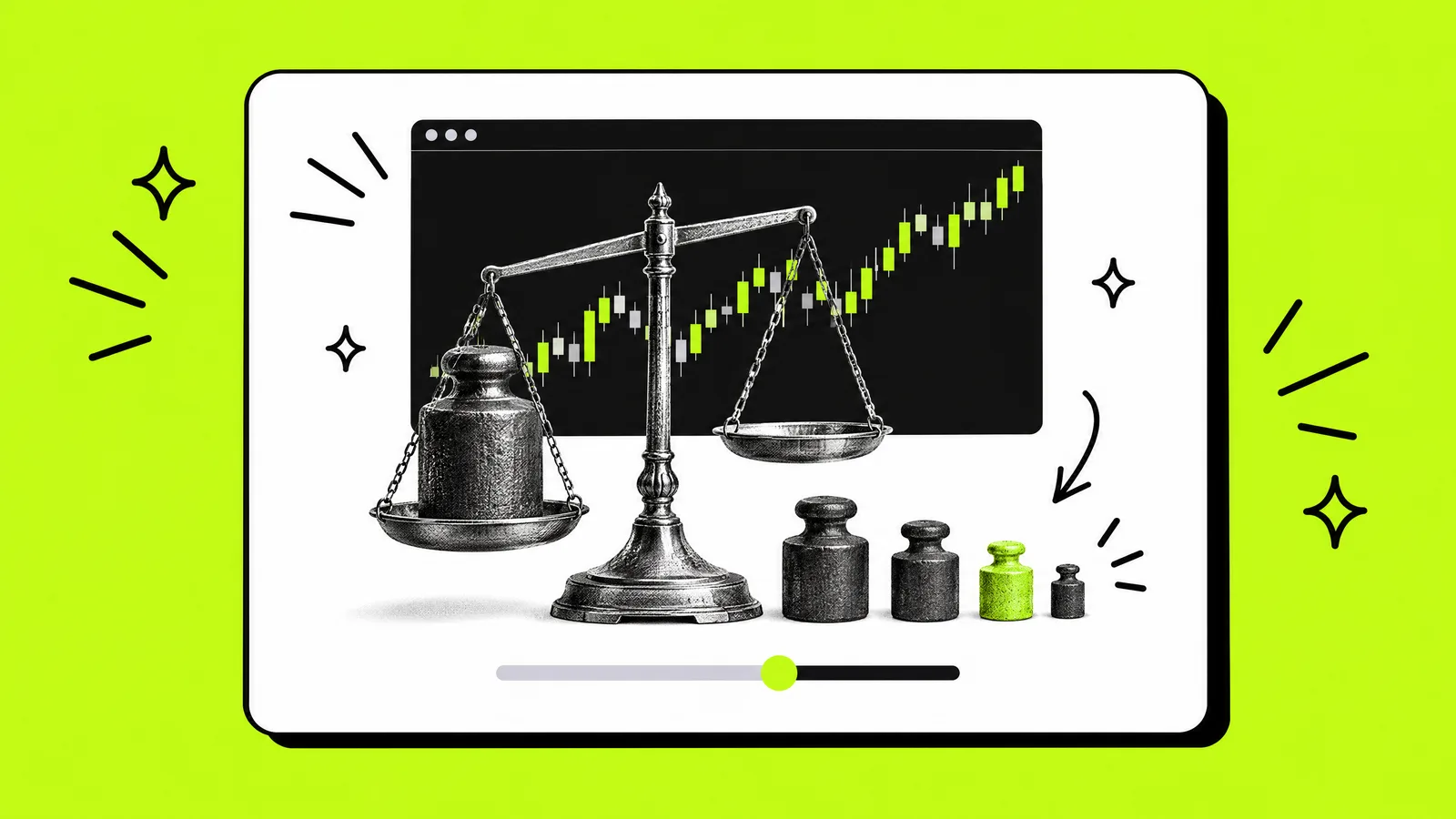
Spreads, stop losses, profit targets, the digit flickering at the end of a quote: all of it is counted in pips. Until you know what a pip in forex actually stands for, a 1.2-pip spread and a 25-pip stop are just numbers you can't compare.
Ask a few traders "what is a pip in forex trading?" and most will say "a small price move". True, but that's half the answer. The half that matters is what the move costs or pays in your own account currency, on the size you really trade, and few people can do that sum in their head.
We'll start with pip size and the pip, pipette and point mix-up in MetaTrader, get to the pip value formula, and finish with the sums that touch your balance: P&L, position size and costs.
What Is a Pip in Forex Trading?
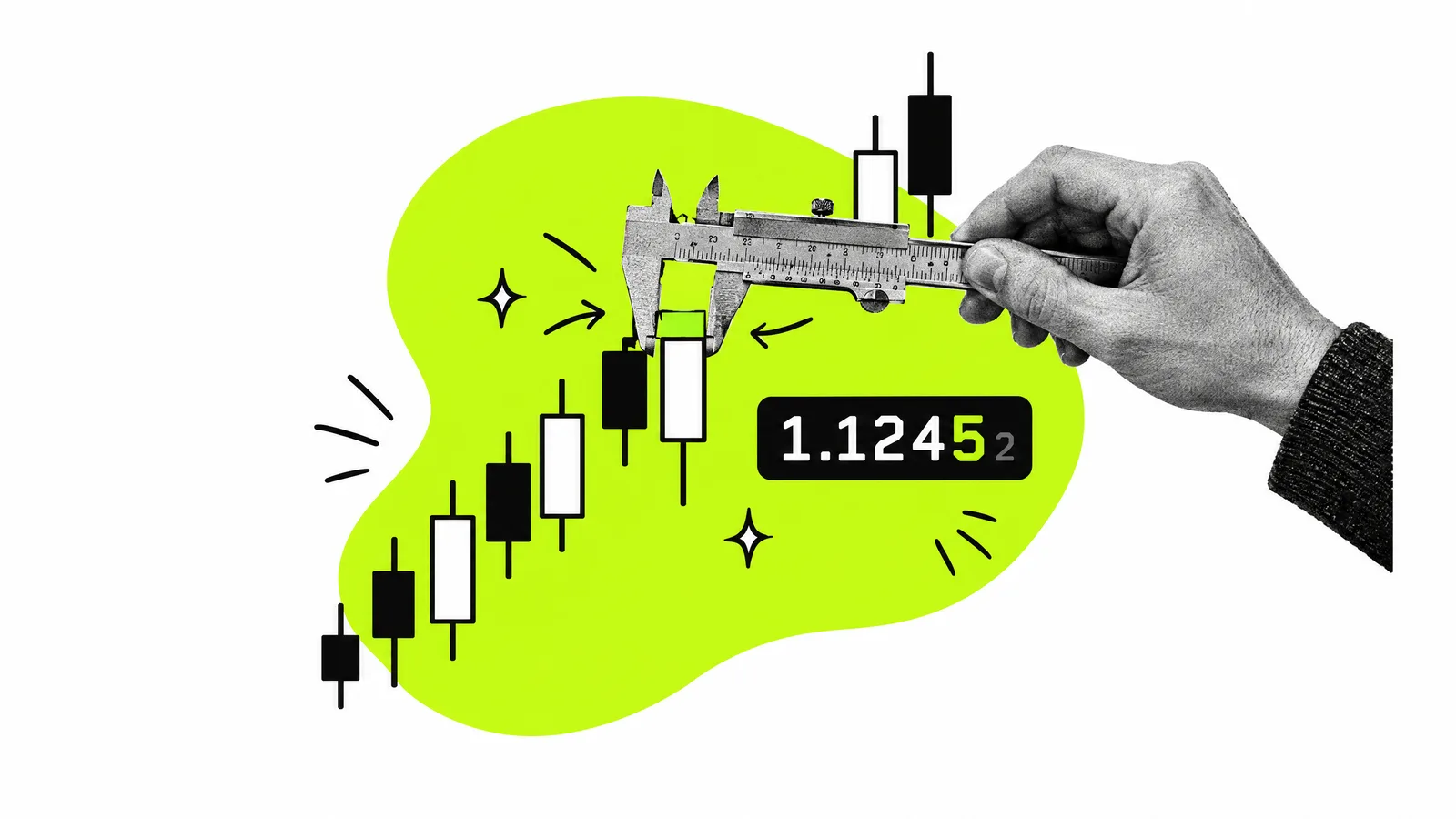
A pip is the standard unit for measuring a change in a currency pair's exchange rate. On most pairs one pip is 0.0001, the fourth decimal place, or 1/100 of 1%. EUR/USD going from 1.1245 to 1.1246? That's one pip. Spreads, stops and results all use the same unit.
The name is usually decoded as "percentage in point", though "price interest point" is in circulation too. So what is pip in forex terminology for, day to day? It's a shared ruler. EUR/USD trades around 1 and USD/JPY above 100; without a common unit, comparing moves on the two would be guesswork.
A bit of history explains today's confusion. The pip used to be the smallest step a dealer would quote, until brokers switched to fractional pricing and tacked on an extra digit. Hence 1.12452 rather than 1.1245. That fifth digit is a slice of a pip.
Pip Size by Currency Pair and Instrument
On most currency pairs the pip is the fourth decimal (0.0001), while on JPY pairs and other low-value quote currencies such as HUF it's the second (0.01), simply because one yen or forint is worth a tiny fraction of a dollar, euro or pound. The quickest way to find it on a live quote is to count decimals: in 1.12452 the pip is the 5, in 158.385 it's the 8.
| Instrument type | Example symbol | Quote format (hypothetical price) | Pip position | Pip size |
|---|---|---|---|---|
| Major pair | EUR/USD | 1.12452 | 4th decimal | 0.0001 |
| USD-base pair | USD/CAD | 1.37215 | 4th decimal | 0.0001 |
| JPY pair | USD/JPY | 158.385 | 2nd decimal | 0.01 |
| JPY cross | EUR/JPY | 177.734 | 2nd decimal | 0.01 |
| Gold CFD | XAUUSD | 4,134.18 | Set by broker | Commonly 0.01 or 0.1; check contract specification |
| Index CFD | US500 | 6,850.2 | Set by broker | Set by broker; check contract specification |
Gold, indices, energies and crypto CFDs, often held in the same account, are a different story: there's no universal pip. Each broker sets the price step and defines what its platform calls a pip in the contract specification, so open the specific symbol's spec before calculating.
Pips vs Pipettes vs Points
A pipette is a tenth of a pip: the fifth decimal on most pairs, the third on JPY pairs. MetaTrader 4 and 5, the retail platforms many brokers offer, add a third unit called the "point", one step of the last quoted digit. Going by the MQL5 Reference on symbol properties (SYMBOL_POINT and SYMBOL_DIGITS), one point equals one pipette on 5-digit and 3-digit quotes, so 10 points make a pip.
| Unit | Size on EUR/USD | Size on USD/JPY | Where you see it |
|---|---|---|---|
| Pip | 0.0001 | 0.01 | Spreads quoted by brokers, trading plans, statements |
| Pipette | 0.00001 | 0.001 | The last digit of a live quote; raw spreads such as 0.2 pip |
| MT4/MT5 point | 0.00001 | 0.001 | Stop loss and take profit distances, the spread column in Market Watch |
Here's where it bites. The same documentation counts the spread and the minimum stop distance in points, not pips. Type a 200-point stop loss into MT5 and you've set 20 pips; mix the units up and the stop lands ten times closer or wider than you meant. Pipettes are also why a raw-spread account can show 0.2 pip at all. In index markets, though, a "point" is a whole-number price unit unrelated to forex points.
How to Count Pips Between Two Prices
To count pips between any two prices on a chart, take the lower price from the higher and divide by the pair's pip size. Direction decides the sign: a long position gains pips when price rises, a short one when it falls. So what are pips in forex? A measure of distance between two prices, with no money attached yet.
- Identify the pip size of the pair: 0.0001, or 0.01 for JPY pairs.
- Subtract the lower price from the higher price.
- Divide the difference by the pip size.
- Read the fifth (or third) digit as tenths of a pip.
Example 1, EUR/USD (hypothetical prices). A long position opens at 1.12452 and closes at 1.12927.
1.12927 − 1.12452 = 0.00475
0.00475 ÷ 0.0001 = 47.5 pips gained
Example 2, USD/JPY (hypothetical prices). A short this time, opened at 158.385 and closed at 157.705.
158.385 − 157.705 = 0.680
0.680 ÷ 0.01 = 68.0 pips gained
What Is Pip Value?
Pip value is how much money a one-pip move adds to or takes from your position, in your account currency. Three things set it: the pair's pip size, your position size in units or lots, and the exchange rate that converts the result into your account currency.
Position size comes in lots, and on a USD-quoted pair in a USD account the maths is pleasantly linear. That's where the famous "$10 per pip per standard lot" comes from, and the only place it holds; change the pair or account currency and it drifts with the exchange rate. Why do textbook examples love dollar pairs? Partly habit, partly scale: the US dollar was on one side of 89% of all FX trades in April 2025, according to BIS Triennial Central Bank Survey 2025 data.
| Lot type | Units of base currency | Pip value on EUR/USD in a USD account |
|---|---|---|
| Standard lot | 100,000 | $10.00 |
| Mini lot | 10,000 | $1.00 |
| Micro lot | 1,000 | $0.10 |
| Nano lot | 100 | $0.01 (not offered by every broker) |
Leverage, by the way, doesn't move pip value at all. It decides how much margin you put up, nothing more. Pip value is also what turns any cost or rebate quoted in pips into money. BrokerFlat skips that step by quoting every rebate rate as a fixed USD amount per lot.
How to Calculate Pip Value in Forex
Multiply pip size by position size in units and you have pip value, in the quote currency. Account in a different currency? Convert at the current exchange rate. The same steps show how to calculate pip in forex value for any pair and any account.
Pip value (quote currency) = pip size × position size in units
- Find the pip size of the pair (0.0001 or 0.01).
- Convert the lot size into units (1 standard lot = 100,000).
- Multiply pip size by units to get pip value in the quote currency.
- Convert that amount into your account currency if the two differ.
When the Quote Currency Matches Your Account Currency
The easy case. GBP/USD or EUR/USD on a USD account needs no conversion, and you get the same $10 you saw in the lot table.
GBP/USD, 1 standard lot: 0.0001 × 100,000 = $10 per pip
When the Base Currency Matches Your Account Currency
With USD/JPY, USD/CAD or USD/CHF the dollar is the base currency, so pip value lands in yen, Canadian dollars or francs. One division by the current rate brings it back to USD.
USD/JPY, 1 standard lot, hypothetical rate 158.385:
0.01 × 100,000 = ¥1,000 per pip
¥1,000 ÷ 158.385 = $6.31 per pip
Cross Pairs and Non-USD Accounts
Most guides skip this one. On EUR/GBP in a USD account neither currency is yours, so work out pip value in pounds first, then convert at GBP/USD, the rate that links the quote currency to your account currency.
EUR/GBP on a USD account, 1 standard lot, hypothetical GBP/USD rate 1.3250:
0.0001 × 100,000 = £10 per pip
£10 × 1.3250 = $13.25 per pip
On a EUR account trading EUR/USD you divide instead: $10 ÷ 1.1245 = €8.89 per pip.
Pip Value on Gold (XAUUSD)
On gold the money result is price change in USD × contract size in ounces × lots; the "pip" is just a label on top. Brokers differ on both inputs: contract size is commonly 100 troy ounces, the trading unit of the COMEX Gold futures contract (CME Group Rulebook, Chapter 113), though 10 oz and 1 oz contracts exist too, and the pip is 0.01 at some brokers and 0.1 at others.
Hypothetical $1.00 price move on a 100 oz lot:
1 lot: $1.00 × 100 oz × 1 = $100
0.01 lot: $1.00 × 100 oz × 0.01 = $1
Same move in pips: 100 if the pip is 0.01, 10 if it's 0.1. The money doesn't change, which is why "1,000 pips on gold" can mean a $10 move or a $100 one.
The XAUUSD contract specification in your platform settles both numbers.
Why pip value changes over time. If the account currency isn't the quote currency, pip value floats with the exchange rate. Take one standard lot of USD/JPY: ¥1,000 ÷ 158.385 = $6.31 per pip at a hypothetical entry, ¥1,000 ÷ 150.000 = $6.67 at a hypothetical exit.
For rebates rather than pips, the forex rebate calculator runs the numbers on your own lot size and trade count.
Using Pips to Calculate Profit, Loss and Position Size
Pip value does two jobs here: it tells you what a trade made or lost, and how big a position you can open before a stop loss costs more than you'll accept. Position sizing limits the planned loss at your stop; it won't change the odds of a trade or boost returns. Both calculations are good practice on a demo account before live trades.
P&L = pips moved × pip value per lot × number of lots
Winning outcome: long 0.5 lots of EUR/USD, price rises 47.5 pips.
47.5 × $10×0.5=+$237.50
Losing outcome: the same position, price falls 30 pips.
−30 × $10×0.5=-$150.00
- Decide the most you're prepared to lose on this trade.
- Set the stop-loss distance in pips.
- Find the pip value per lot for the pair and your account currency.
- Divide the risk amount by (stop distance × pip value per lot).
Example with hypothetical figures: account balance $5,000, risk set at 1% as an example, so $50. Stop distance 25 pips on EUR/USD, pip value $10 per lot.
$50 ÷ (25 × $10) = 0.2 lots
How Pips Measure Your Trading Costs
The spread is paid in pips on every trade. On a raw-spread account there's commission too; divide it by pip value and it's in pips as well, then pip value turns both into money. Also: floating spreads can widen around high-impact news on the economic calendar, and swap is a separate overnight cost on positions held past rollover.
| Cost component | How it is quoted | Example per standard lot EUR/USD in pips | Example in USD |
|---|---|---|---|
| Spread (spread-only account) | Pips, built into bid/ask | 1.2 | $12 |
| Spread (raw-spread account) | Pips, built into bid/ask | 0.2 | $2 |
| Commission per round turn | Money per lot | 0.7 | $7 |
| Total, spread-only account | 1.2 | $12 | |
| Total, raw-spread account | 0.9 | $9 | |
| Rebate per lot (hypothetical) | Fixed USD per lot, per round turn | 0.3 | $3 |
| Net cost after rebate | 0.9 (spread-only) / 0.6 (raw-spread) | $9 / $6 |
All figures are hypothetical. A forex rebate returns part of those trading costs per lot: say a broker pays $3 per lot, which on EUR/USD works out to $3 ÷ $10 = 0.3 pips. In the raw-spread column that takes the round turn from 0.9 down to 0.6 pips. Real rates vary by broker, instrument and account type; see them for BrokerFlat partner brokers.
A rebate lowers your costs; it doesn't change whether a strategy is profitable.
Summary: What a Pip Means for Your Account
Short version: a pip is the fourth decimal on most currency pairs and the second on JPY pairs, and on 5- and 3-digit quotes a pipette, or an MT4/MT5 point, is a tenth of that. On CFDs the broker's contract specification has the final word.
Pip value is what turns a pip count into money, and it's built from pip size, position size and the exchange rate to your account currency. Get that figure right and the rest follows: P&L, lot size for a given risk, the cost of every round turn.
Now that you can price a pip, check how much of your spread comes back. Plug your lot size and daily trades into the BrokerFlat forex rebate calculator and you'll see your monthly and yearly rebate in USD.