Every forex trade starts with a cost paid before commission or swap: the spread. So what is spread in forex? It is the gap between the buying and selling price, and you cross it the moment a position opens.
Most guides stop there. They skip how a quoted spread in forex turns into dollars per trade and how it stacks with commission. They also skip why the spread you pay at 5 pm New York can far exceed the advertised one.
This guide covers the definition, the calculation in pips and money, fixed, variable and raw spreads, what widens them, how to judge a spread and how to pay less. The spread is treated purely as a cost of execution: a lower one makes a trade cheaper, not more likely to work.
What Is Spread in Forex?
The spread in forex is the difference between the bid and the ask price of a currency pair. A buyer opens at the ask and closes at the bid; a seller opens at the bid and closes at the ask. The spread is measured in pips, and it is the price a trader pays for immediate execution.
The two prices in every quote:
- Bid: the price at which you can sell the base currency.
- Ask: the price at which you can buy the base currency.
A retail spread has two layers: the bid and ask streamed by liquidity providers, plus any broker markup. EU rules treat that markup as a client cost: ESMA's MiFID II Q&A on costs and charges works from the principle that every difference between the firm's price and the client's price, including mark-ups, should be disclosed.
For a beginner, the important point is that a "commission-free" account still costs money to trade; the broker earns inside the price. The spread is a fee for not waiting: you trade this second instead of searching for a counterparty at your price. For the unit itself and how pip value works, see What Is a Pip in Forex Trading and How to Calculate Its Value.
How to Calculate the Spread in Pips
To calculate the spread in pips, subtract the bid from the ask and divide the result by the pair's pip size: 0.0001 for most pairs and 0.01 for JPY pairs. On 5-digit and 3-digit quotes, the last digit is a tenth of a pip, so the result can be fractional, such as 0.9 pips.
Spread (pips) = (Ask − Bid) ÷ Pip size
- Read both sides of the live quote in the platform.
- Subtract the bid from the ask.
- Divide the difference by the pair's pip size.
- Read the extra fifth (or third) decimal as tenths of a pip.
Example 1, EUR/USD (hypothetical quote):
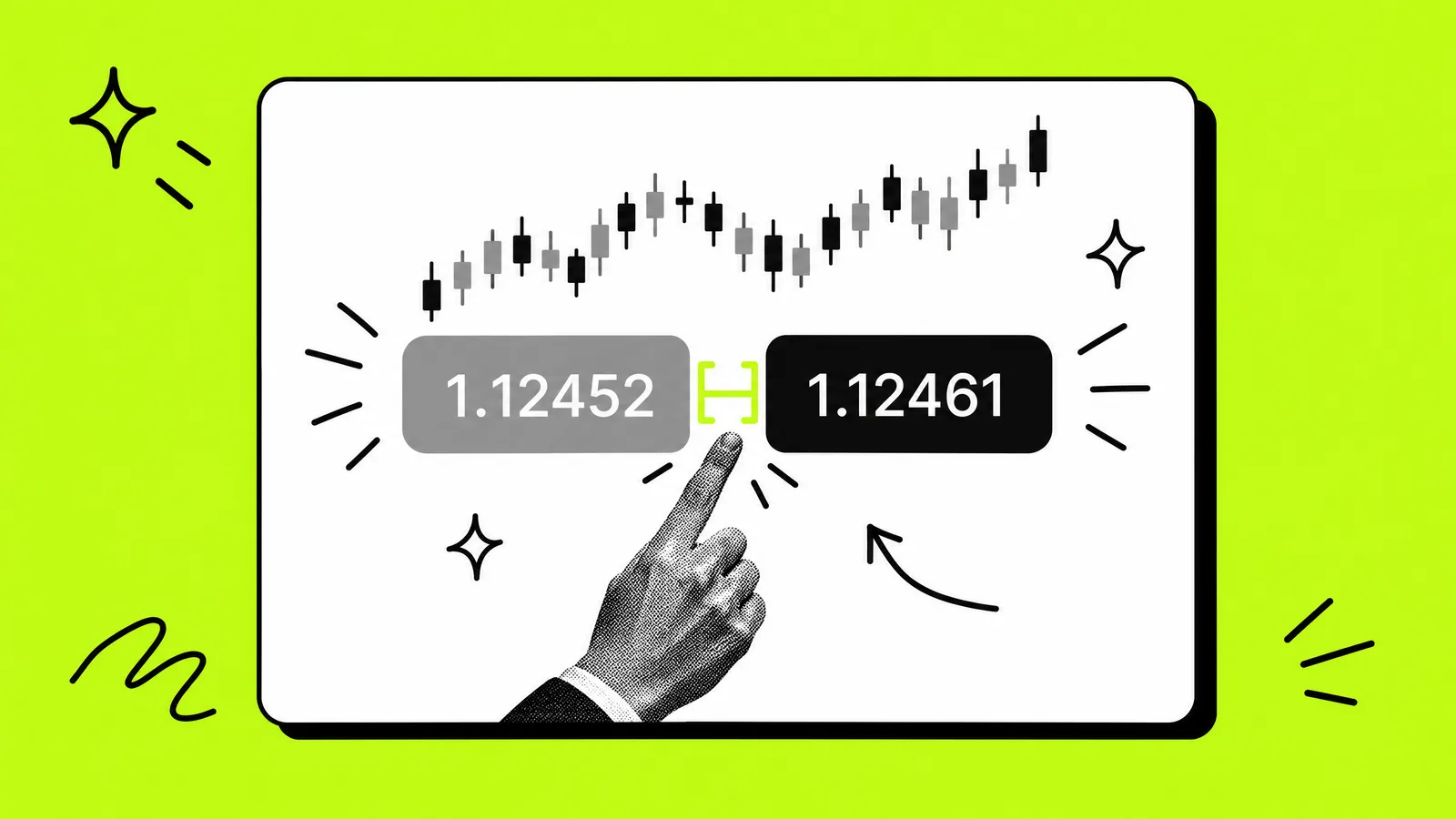
1.12461 − 1.12452 = 0.00009
0.00009 ÷ 0.0001 = 0.9 pips
Example 2, USD/JPY (hypothetical quote):
158.401 − 158.385 = 0.016
0.016 ÷ 0.01 = 1.6 pips
MetaTrader reports the spread in points, the smallest price step of a symbol. The MQL5 Reference on symbol properties defines SYMBOL_SPREAD as the spread value in points. On 5-digit and 3-digit quotes, 10 points equal 1 pip, so a reading of 9 means 0.9 pips. Per MetaTrader 5 Help, bars are built from Bid prices and the Ask is not displayed, so enable "Show Ask price line" to see the spread on the chart.
What Is Spread Cost in Forex?
Spread cost is the money traders pay for crossing the bid-ask gap. It is calculated as spread in pips times pip value per lot times lots, in your account currency. A new position opens at a loss equal to this cost, and price will need to move that far to break even.
Spread cost = Spread (pips) × Pip value per lot × Lots
- Measure the spread in pips at the moment of entry.
- Find the pip value per lot in your account currency.
- Multiply by the position size in lots.
Worked example (hypothetical, USD account): EUR/USD spread 1.0 pip, pip value $10 per standard lot, position 2 lots
1.0 × $10 × 2 = $20 per trade
80 such trades in a month: $20 × 80 = $1,600 in spread cost
Double the size or the trade count and the bill doubles. Understanding the round turn matters too: with an unchanged spread you pay one full spread per round turn: measured from mid price, half at entry and half at exit. Open at a 1.0-pip spread and close after it widens to 3.0 pips, and the round turn costs 0.5 + 1.5 = 2.0 pips.
The same spread weighs very differently on different targets:
| Trading style | Take-profit distance in pips (hypothetical) | Spread in pips (hypothetical) | Spread as share of target |
|---|---|---|---|
| Scalping | 5 | 1.0 | 20% |
| Intraday | 25 | 1.0 | 4% |
| Swing | 150 | 1.0 | 0.67% |
Pip value is $10 per lot only on USD-quoted pairs with a USD account; for others, convert it as in the pip value guide. Commission-based accounts add a per-lot commission on top. Swap is a separate overnight cost.
A rebate offsets part of this cost. Say a broker pays a hypothetical $5 per lot per round turn through BrokerFlat. In the example above, the spread costs $10 per lot, so the net cost becomes $10 − $5 = $5 per lot, or 0.5 pips. Actual rates depend on the broker, instrument and account type; check them on the BrokerFlat partner brokers page. A rebate lowers your costs; it doesn't change whether a strategy is profitable.
Work out what your own trading would pay back
Enter your broker, your instrument and your monthly lots to see the rebate on your own volume rather than on an example.
Calculate your rebateFixed vs Variable Spreads
A fixed spread stays at a set width under normal conditions, while a variable (floating) spread moves with market liquidity tick by tick. Fixed spreads usually come from dealing-desk pricing; variable spreads come from prices passed through from liquidity providers.
| Feature | Fixed spread | Variable spread |
|---|---|---|
| How the width behaves | Stays at a set level in normal conditions | Changes with every quote update |
| Typical pricing model | Dealing desk (market maker) | Pass-through pricing from liquidity providers (STP/ECN) |
| Cost predictability | Known in advance | Known only at the moment of entry |
| Behaviour during news | May hold, but quotes can be suspended or adjusted | Widens as liquidity thins |
| Main execution risk | Requotes or slippage | Wider spread at entry or exit |
To check a symbol in MetaTrader, the SYMBOL_SPREAD_FLOAT property flags a floating spread, per the MQL5 symbol properties reference. Without code, watch the spread in Market Watch: a value that changes every tick is floating.
What Is Raw Spread in Forex?
A raw spread is the liquidity provider's bid-ask gap passed to the trader with little or no markup, with a separate commission charged per lot instead. In liquid hours the quote can show 0.0 pips. In cost terms, what is raw spread in forex comes down to the raw spread plus the commission converted into pips.
It is the same cost split into two lines, with part of the price moved into a visible commission. Commission is quoted per side (open and close each) or per round turn. A $3.50-per-side rate equals $7 per round turn, and mixing the two halves or doubles the real figure.
All-in cost (pips) = Raw spread (pips) + Round-turn commission ÷ Pip value per lot
| Pair | Pip value per standard lot (hypothetical rate) | Raw spread in pips (hypothetical) | Round-turn commission in USD (hypothetical) | Commission in pips | All-in cost in pips | Spread-only spread at equal cost |
|---|---|---|---|---|---|---|
| EUR/USD | $10.00 | 0.1 | $7.00 | 0.70 | 0.80 | 0.8 pips |
| USD/JPY | $6.31 (at 158.40) | 0.2 | $7.00 | 1.11 | 1.31 | 1.3 pips |
The same $7 is 0.70 pips on EUR/USD but 1.11 pips on USD/JPY, because a USD/JPY pip is worth less in dollars. The last column is break-even: a spread-only account quoting below it is cheaper on that pair. During news the commission stays fixed, while the raw spread still widens. For a single-pair comparison of both account types with a rebate line, see the pip article.
FIBO Group cashback rate per lot

FIBO Group
$3.00 per lot on forex
This article compares a spread-only account with a raw-spread account on an all-in basis, where the commission has to be converted into pips before the two are comparable. FIBO Group lists its account types side by side with the cashback rate for each, so the rebate belongs inside that all-in figure rather than beside it.
View FIBO Group cashback ratesWhen and Why Spreads Widen
The main factors are liquidity and risk: spreads widen when liquidity providers have fewer counterparties to hedge with or face more price risk. Most of these moments are predictable: thin pairs, quiet sessions, the 5 pm New York rollover, major data releases, the weekly open and holidays.
| Factor | Why it changes the spread | When to expect it |
|---|---|---|
| Pair liquidity | Deep two-way flow lets providers quote tight prices; exotics have fewer market makers | Always: majors tightest, crosses wider, exotics widest |
| Trading session | More active participants compete on price | Tightest in the London–New York overlap; wider after the New York close |
| Daily rollover | Banks close books and liquidity providers step back | Around 5 pm New York time, for roughly an hour |
| Scheduled economic releases | Providers widen quotes before uncertain prints | Central bank decisions, NFP, CPI |
| Weekly open and holidays | Thin order books after the weekend break or on bank holidays | Sunday evening open; national holidays in major centres |
| Unexpected events | Sudden one-way flow with few counterparties | Any time, amplified in thin hours |
| Broker markup | Added on top of the provider price | Depends on account type; stated in the account terms |
Preliminary results of the BIS Triennial Central Bank Survey 2025 put global FX turnover at $9.6 trillion per day in April 2025, with spot at 31% of the total and the US dollar on one side of 89% of all trades. The final data in the BIS Quarterly Review put total turnover at $9.5 trillion. The survey month saw elevated volatility after trade policy announcements, per the BIS turnover commentary. Our explanation, not a BIS finding: concentrated USD flow is why USD majors carry the tightest spreads.
The daily close is the sharpest routine example. CME Group's analysis of the FX daily close explains that at 5 pm New York the value date rolls, banks close their books and many liquidity providers pull back. That often makes it the least liquid hour of the day. Thin hours also magnify shocks: the BIS Markets Committee report on the sterling flash event of October 2016 places significant weight on the time of day, early Asian trading, as a factor behind the move.
Widening hits open positions twice. Per MetaTrader 5 Help on order types, a long stop is checked against the Bid and a short stop against the Ask. A wider spread can therefore trigger a short's stop while the Bid chart never reaches it. And because positions are valued at their closing price, a wider spread cuts equity and margin level, moving the account toward a margin call or stop out.
What Is a Good Spread in Forex?
What is a good spread in forex depends on the pair, your trading hours and the all-in cost after commission; no number fits every pair. A good spread sits at the low end of that pair's range in your hours. Lower is cheaper, and 1 pip can be low for one pair and high for another.
- Identify the pair class: major, cross or exotic.
- Compare average spreads, not the minimum "from" figure in adverts.
- Add any commission to get the all-in cost.
- Compare in money per lot or as a percentage of price, not in raw pips.
- Check the spread during the hours you actually trade.
Pip counts don't compare across pairs: a pip has a different money value and a different weight relative to the exchange rate.
Spread (% of price) = (Ask − Bid) ÷ Mid price × 100
Worked example (hypothetical quotes, both with a 1.0-pip spread):
EUR/USD: 0.0001 ÷ 1.12456 × 100 = 0.0089%, worth $10.00 per standard lot
USD/JPY: 0.01 ÷ 158.393 × 100 = 0.0063%, worth $6.31 per standard lot
Same pip count, but the USD/JPY spread is about 30% smaller relative to price.
Find spread data in this order: the symbol's contract specification and the broker's published average spreads where offered, then the live spread at your trading hours. For EU-licensed entities, the MiFID II costs and charges disclosure (see the ESMA Q&A above) adds the broker's own cost figures.
How to Lower Your Spread Costs
You lower spread costs by trading when and where liquidity is deepest, checking the spread before entry and choosing an account structure from the all-in arithmetic. None of these steps changes the risk of the strategy itself.
- Trade liquid pairs during the London–New York overlap.
- Avoid entries and exits around the 5 pm New York rollover.
- Stay out of the weekly open and the minutes around scheduled releases.
- Check the live spread in Market Watch before every entry.
- Pick raw or spread-only pricing from the all-in cost on your pairs.
- Set profit targets wide enough that the spread is a small share.
A rebate also returns part of the spread or commission on each trade; work it out for your own lot size and trade count with the forex rebate calculator.
Key Takeaways on Forex Spreads
The spread is the bid-ask gap you pay on every trade for instant execution. In money it is spread in pips times pip value times lots, paid once per round turn when it stays unchanged.
Raw-spread accounts move part of that cost into a commission, so compare them only on an all-in basis. What you actually pay depends on the pair, session, rollover, scheduled news and broker markup, so run the all-in figure on your own pairs and hours.
Every pip of spread is a cost you pay on each trade. Compare how much each partner broker returns per lot of spread or commission on the BrokerFlat brokers page.